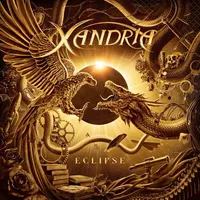
Eclipse

A Band That Learned to Survive Its Own Changes
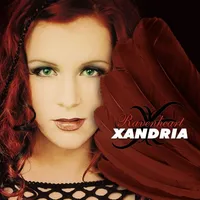
There are bands that build their identity like a wall, brick by brick, over the years. Xandria built theirs in a much less predictable way. Formed in Germany and led by guitarist and composer Marco Heubaum, the band emerged in 1994 exploring gothic territory before consolidating its connection with symphonic metal and power metal. More than two decades later, the group's history is also marked by successive lineup changes, especially on vocals. Ambre Vourvahis took on this role in the lineup introduced in 2022 and now returns on what is the band's ninth studio album, Eclipse.
I go into Eclipse with this history in mind. I am not looking at a band trying to discover who it is, but at a group that seems to have decided to place its entire repertoire of experiences within the same frame. The result is an album that sounds big, confident, and carefully constructed, as if Xandria had finally found enough room to accommodate all of its ambitions.
The Impact of a Monumental Production
What initially jumps out at me is that Eclipse is the album of a band with absolutely no interest in working on a small scale. The guitars have weight, the orchestrations occupy plenty of space, and the melodies were designed to reach dimensions larger than the arrangements themselves. There is an obvious concern with making every element feel like part of a spectacle, but without turning metal into mere accompaniment for symphonic grandeur. The album places the imposing orchestrations and the strength of the guitars side by side, allowing the rhythm section to actively participate in this construction.
I particularly like this balance. Instead of letting the orchestrations swallow the guitars, Eclipse often makes the two worlds collide. At certain moments, the music seems to wear steel armor over a formal gown. The result is exuberant, but not entirely ornamental, there is physical strength behind all that pomp.
Melody, Weight, and a Voice at Center Stage
Another aspect that catches my attention is the way Ambre Vourvahis fits into this sound. Her presence emerges as one of the album's strengths, especially because of her ability to move between more delicate passages and moments of greater intensity. I perceive exactly this function when I listen to the album, her voice is not there merely to embellish the orchestrations, but to serve as the axis between the different musical layers.
This helps Eclipse avoid being trapped at a single temperature. The album knows how to be melodic without completely losing its teeth and how to be heavy without abandoning its symphonic appeal. The more aggressive moments, in fact, work as a kind of counterbalance to the exuberance of the arrangements. It is an important dynamic because it prevents the experience from simply becoming a succession of grand melodies over a wall of orchestration.
A Giant That Knows the Way Well
There is, however, one characteristic of Eclipse that I cannot ignore: its familiarity. Xandria competently delivers what is expected from a great symphonic metal album, and I also notice that the record is not exactly interested in breaking the genre's boundaries. The band prefers to remain within its own axis, refining a formula it already knows very well, rather than looking for a completely different direction.
For me, this is simultaneously its strength and its main limitation. The band knows the mechanisms that make this kind of music work, expansive melodies, dramatic orchestrations, easy-to-absorb choruses, and changes in intensity capable of amplifying the impact. All of this is executed with confidence. But precisely because the band knows the road so well, Eclipse rarely seems willing to leave it to discover what lies beyond the next bend.
I do not consider this a flaw capable of bringing the album down. On the contrary, the execution is convincing enough to turn a familiar formula into an enjoyable experience. But after a few listens, I notice that the element of surprise diminishes. Xandria demonstrates that it knows how to build a great symphonic metal album. What is missing, at times, is the feeling that it is trying to build something that could only have come from them.
When Excess Works
The curious thing is that Eclipse seems to understand perfectly well that its greatest risk lies precisely in excess. There is a lot happening, layered orchestrations, grand vocals, heavy guitars, choirs, and melodies designed to make an impact. Even so, the overall impression remains relatively cohesive. I never feel that I am facing a completely disconnected collection of ideas.
At the same time, this abundance can make the experience somewhat predictable. When the music calls for drama, Xandria tends to increase the size of the sonic landscape, and when it needs impact, it adds weight, when it seeks emotion, it turns to melody. It is an efficient language, but one that leaves few areas of shadow. Eclipse prefers to illuminate everything with spotlights rather than leave some parts hidden in the dark.
A Step Toward Assertion
After listening to the album as a whole, my impression is of a more confident band that is more aware of what it wants to deliver. Eclipse does not strike me as a transitional work nor as a simple exercise in repeating the past. It is an album that takes the experience accumulated by Xandria and presents it with a broad, heavy, and extremely polished production.
I think the band has reached one of its strongest moments precisely because it managed to unite competence, ambition, and enough identity to sustain eleven tracks within a rather demanding proposition. At the same time, I cannot ignore that this same confidence reduces the element of risk. Eclipse wants to win you over, not provoke you. It wants to erect a monument, but not necessarily tear down a wall.
In the end, that is precisely where I find the personality of this album. Eclipse does not try to turn symphonic metal into something else. It looks at this universe, knows its mechanisms, and decides to operate all of them at the limit. More weight, more melody, more orchestration, and more impact. I might have wanted Xandria to dare a little more, but I cannot deny the effectiveness of this frontal assault. It is an album of grand proportions, performed by musicians who know exactly how to make this machine work, and when it accelerates, it is difficult not to get on board.