Verbolgen
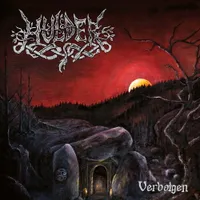

Hulder: Between the Blade and the Mist
There are black metal albums that seem to want to simply crush everything they encounter. Others prefer to slip through the cracks, leave a few images in your head, and only then show their teeth. Hulder belongs to both worlds, but in Verbolgen I perceive a band increasingly interested in discovering what happens when violence ceases to be the only center of gravity in the music.
Throughout its career, Hulder has built an identity firmly connected to traditional black metal, preserving that combination of harshness, darkness, and melodies that evokes the old school without turning reverence for the past into a mere period fantasy. Previous releases had already shown a band comfortable within this language, but also willing to expand its possibilities. On Verbolgen, this characteristic becomes even more evident, the essence remains intact, but the songwriting seems to breathe through wider spaces.
An Album That Grows in the Dark
My first impression when listening to Verbolgen is that it is not interested in winning me over solely through immediate impact. There is weight from the beginning, of course, but it comes accompanied by a melodic layer that gives the songs a broader dimension. The guitars continue to carry much of the band's identity, alternating fast and abrasive attacks with lines that seem to emerge from an ancient, cold, and distant landscape.
It is precisely in this combination that I find the album's personality. The aggression does not disappear, it simply stops functioning as a continuous wall. There are moments when it advances like a storm and others when it retreats enough for the melodies to emerge. This alternation gives the album a sense of movement that I consider fundamental to its strength.
When the Riff Becomes More Than Just Impact
In many moments, I find the guitars less concerned with simply delivering that riff that immediately grabs you by the throat and more interested in building the environment around the music. The tremolos, layers, and changes in direction work together to make each composition feel larger than its individual structure.
This does not mean that Verbolgen has abandoned moments of pure ferocity. They are still present and are important precisely because they contrast with the more melodic and contemplative passages. What changes is the proportion. Instead of relying exclusively on brute force, Hulder seems to want the weight to have emotional consequences.
It is a subtle but noticeable difference. I feel less of a need to follow each riff as if it were an isolated blow and more of an impression that I am moving through a composition that keeps changing shape before me.
Melody Without Losing the Darkness
If there is one element that stays in my mind after a few listens, it is the way the melodies coexist with the dark atmosphere. They do not function as an attempt to soften the black metal. They often make the music even more unsettling.
There is a melancholic quality to these passages, sometimes majestic, sometimes almost contemplative. Acoustic elements and timbres that evoke an ancient sound expand this feeling, creating a kind of medieval landscape filtered through a black mist. I do not feel that these details are there merely to embellish the album, they help expand the musical identity of Verbolgen.
The result is an album in which beauty and harshness do not seem like enemies. They share the same space, and it is precisely this coexistence that makes the atmosphere so striking.
Compositions That Know How to Wait
Another characteristic that I consider important is the way the songs develop. Verbolgen does not rely exclusively on short and predictable structures to maintain intensity. The compositions have room to change pace, introduce new ideas, slow down, and build up strength again.
This makes a difference because the album also begins to work with anticipation. Instead of delivering everything at once, some passages seem to prepare the ground for what comes next. The drums follow these changes with precision, alternating moments of great speed with sections in which the weight is more concentrated in the rhythm and the foundation of the music.
The vocals remain aggressive and perfectly integrated into this setting. They do not seek to steal attention from the guitars, but function as another layer of the atmosphere, maintaining that sense of hostility that prevents the album from becoming excessively contemplative.
A Production That Lets the Album Breathe
The production also helps this approach. Verbolgen does not sound like an exercise in excessive polish, but neither does it seem interested in that deliberately weakened aesthetic that sometimes turns black metal into an indistinct mass of noise. There is enough warmth, presence, and definition for the different elements to find their space.
I can better perceive the relationship between weight and melody precisely because the sound does not suffocate either of them. The guitars remain abrasive, the drums retain their impact, and the vocals carry their brutality, but there is room for the details to emerge. It is a production that favors the experience of the album as a whole.
Less Urgency, More Depth
It is precisely here that I see the main characteristic of Verbolgen: it seems less interested in proving its ferocity every minute. Compared to the aggression that marked the band's previous releases, there is a greater willingness to let the songs grow, breathe, and explore their own ideas.
For me, this does not represent a loss of weight, but a change in the way it is used. The impact no longer depends solely on speed or crushing riffs and instead also emerges from contrast. A melodic passage can make the return of the drums more powerful, a slowdown can make the next explosion feel bigger, a more contemplative guitar can make an aggressive sequence even darker.It is like replacing a continuous blow with a blade that knows when to remain still before cutting.
An Evolution Within an Ancient Language
The band works with a well-known language, but demonstrates enough confidence to rearrange its elements without losing its own personality.The album does not give me the feeling of a band trying to abandon what made it recognizable. It feels like a band that knows its tools very well and is now more interested in exploring what it can do with them. The evolution lies less in creating a new language and more in the ability to extract new possibilities from an old one.
The Weight of an Atmosphere
After a few listens, what stays with me is not only the violence of the guitars or the speed of the drums. It is the atmosphere. Verbolgen has a darkness that does not depend solely on distortion. It is present in the melodies, in the spaces between the attacks, in the changes of pace, and in the way the songs seem to stretch out before fully revealing their intentions.
It is an album that seems more interested in building an experience than in stacking moments of impact. And precisely because of this, its strength emerges gradually. The more attention I give to the details, the more I notice how aggression, melody, and atmosphere were made to work against one another without ever losing their unity.
Conclusion
In the end, Verbolgen leaves me with the impression of a Hulder more confident in its own resources. The band continues to speak the harsh language of traditional black metal, but now seems to understand the silence between the words better. The result is a heavy, melodic, dark, and carefully constructed album that finds its strength not in trying to be more extreme at every moment, but in understanding when brutality needs to advance and when darkness can simply wait.