Dark Asylum
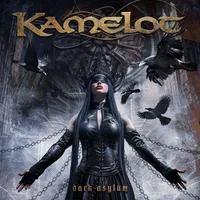

When Metal Finds a Place Where Reason Holds No Sway
I have always had the impression that Kamelot works best when its music seems to be one step away from leaving the stage and entering a theater. Not necessarily because of excessive grandeur, but because of the way the band transforms metal melodies into scenes, characters, and environments. It is a characteristic that has accompanied the group for decades and has given its blend of power metal, progressive elements, and symphonic arrangements a distinctive identity.
Since its earliest works, Thomas Youngblood has guided Kamelot along a very particular path within melodic metal. The band has never relied solely on speed or heaviness to make an impact. Its strength has always been in the combination of guitars, vocals, keyboards, orchestrations, and an almost theatrical inclination toward songwriting. With Tommy Karevik on vocals, this identity found continuity and, over the years, became even more refined.
An Album Built in Layers
Dark Asylum does not take long to reveal its nature. With fifteen tracks, the album is organized as a work of continuous atmosphere, in which the weight of the guitars shares space with keyboards, orchestrations, and vocal melodies. The result is a broad sound, but not simply grandiose for the sake of grandeur. There is a constant concern with filling the spaces and making each song have more than one surface to explore.
The concept of RavenHill Asylum helps tie this experience together. The band itself describes the place as "an imposing institution once built as a grand cathedral, now repurposed into a place where science, faith, and madness uneasily coexist". From this idea, RavenHill serves as the conceptual setting of Dark Asylum and serves as the backdrop for the conflicts explored throughout the album. The record revolves around these ideas, but does not depend on a detailed understanding of the narrative to work. The concept is most effective precisely when it remains as a layer behind the music, I can perceive its presence in the atmosphere, imagery, and tone of the compositions without feeling that I need to decipher an entire story to enjoy the album. It is like walking through a place that seems to have been built to shelter people, but whose very architecture begins to suggest that something is deeply wrong there.
This is where Oliver Palotai's keyboards become important. They do not appear merely as symphonic decoration. At various moments, they help drive melodies, create tension, or fill the sides of the compositions. Thomas Youngblood's guitars, in turn, contribute especially through the leads and melodic lines, while the production keeps everything within a highly polished framework.
The Old Kamelot, but with New Doors
If there is one word I would not use to define Dark Asylum, it is 'rupture'. Kamelot does not seem interested in abandoning its formula. And, listening to the entire album, it becomes clear that this choice is deliberate. There are choruses designed to stay in the head, carefully integrated symphonic passages, and that alternation between heavier moments and more contemplative ones that has long been part of the band's repertoire.
At the same time, I do not feel that the album is simply a mechanical repetition. There are small changes in texture, instrumental combinations, and enough details to prevent every song from seeming to occupy exactly the same space. The problem arises when these variations fail to produce the same impact. Some ideas pass easily through the ear and disappear shortly afterward, while others manage to settle in with much greater force.
This difference in impact is important to understanding the album as a whole. Dark Asylum has moments when Kamelot seems to be operating at its best, especially when melodic guitars, vocals, and orchestrations find a point of balance.
The Voices That Cross the Corridors
The guest appearances are one of the elements that help alter this landscape. On 'Sanctuary', Clémentine Delauney shares the spotlight with Tommy Karevik, and her presence adds a new dimension to the song without seeming like a guest appearance inserted simply to attract attention. Ignacia Fernández also appears on the album, bringing a more aggressive vocal approach that contrasts with the predominantly melodic singing throughout the record.
Tobias Sammet appears on 'One Last Masquerade', and his voice naturally creates an association with the world of Avantasia. For me, the participation works precisely because there is a sense of familiarity between the two vocalists: instead of turning the track into a competition, the encounter adds another color to the album's vocal palette.
Perhaps the most curious guest appearance is that of Rannveig Sif Sigurðardóttir, Sólveig Sara Leupold, and Lea-Sophie Fischer on 'Beneath the Moon (Tunglið)'. The presence of folk elements and Fischer's singing violin moves the song into a different territory from the one normally occupied by Kamelot. It is one of the moments when the album opens a window beyond its usual architecture.
Between Security and Repetition
The most ambiguous aspect of Dark Asylum lies precisely in what is also one of its virtues. I can recognize Kamelot immediately, and that demonstrates how thoroughly the band has established its own language. But that same familiarity makes some moments feel less surprising than they could be.
I do not see this as a problem with execution. Experienced musicians know exactly how to build this kind of music, and the album demonstrates evident technical mastery. The issue lies in the songwriting. When the melodies truly find a strong hook and the arrangements add weight to the central idea, the result is convincing. When that does not happen, the impeccable production cannot completely conceal the lack of impact.
A Familiar Place, Still with Some Rooms Unopened
After listening to Dark Asylum as a whole, I am left with the feeling that Kamelot has found yet another way to inhabit its own universe without having to rebuild it. The album is atmospheric, melodic, detailed, and clearly connected to the identity the band has developed over decades.
What works best is when all these elements stop competing with one another: when the guitar meets the orchestra, the keyboard adds depth, Karevik carries the melody, and the chorus finally opens up space within the music. In these moments, Dark Asylum stops being just another Kamelot album and recaptures that sense of grandeur that helped the band earn its place in symphonic metal.
The album is more like returning to a familiar city and discovering that some streets have changed their names and that there are doors I had never noticed before. Some of those doors lead to genuinely interesting places, while others open only onto familiar corridors. Even so, after three decades, the fact that Kamelot continues to find new ways to illuminate its own labyrinth already says a great deal about the strength of its identity.